Friday, November 30, 2012

Thursday, November 29, 2012
“Truthfulness, honor, is not something which springs ablaze of itself; it has to be created between people. This is true in political situations. The quality and depth of the politics evolving from a group depends in large part on their understanding of honor. Much of what is narrowly termed "politics" seems to rest on a longing for certainty even at the cost of honesty, for an analysis which, once given, need not be re-examined…It isn't that to have an honorable relationship with you, I have to understand everything, or tell you everything at once, or that I can know, beforehand, everything I need to tell you. It means that most of the time I am eager, longing for the possibility of telling you. That these possibilities may seem frightening, but not destructive to me. That I feel strong enough to hear your tentative and groping words. That we both know we are trying, all the time, to extend the possibilities of truth between us.”
― Adrienne Rich
― Adrienne Rich
Wednesday, November 28, 2012
I previously posted an excerpt from this interview, here. He died a few days ago.
INTERVIEWER
Do you think it’s important for American writers to live abroad?
GILBERT
At least at some point—so you have something to compare to what you think is normal, and you encounter things you aren’t used to. One of the great dangers is familiarity.
INTERVIEWER
How did your foreign settings—those places—figure into your poems?
GILBERT
It’s more how those places resonate in me. Rather than writing a poem about those places, they create something I write about.(...)
INTERVIEWER
Is that why your style is unadorned and not ornamental?
GILBERT
Oh, I like ornament at the right time, but I don’t want a poem to be made out of decoration. If you like that kind of poetry, more power to you, but it doesn’t interest me. When I read the poems that matter to me, it stuns me how much the presence of the heart—in all its forms—is endlessly available there. To experience ourselves in an important way just knocks me out. It puzzles me why people have given that up for cleverness. Some of them are ingenious, more ingenious than I am, but so many of them aren’t any good at being alive.(...)
NTERVIEWER
It sounds like even in your San Francisco days you sustained a rather remote life away from others. Is solitude important for you?
GILBERT
I don’t know how to answer that because I’ve always lived a life with a lot of quiet in it—either alone or with someone I’m in love with.
INTERVIEWER
Do you think that being reclusive has preserved your career?
GILBERT
Certainly to the point that it gave me some control over my vanity and helped me keep a grip on what really matters.
INTERVIEWER
You expose a lot of yourself in your poetry. Are your poems taken directly from your life?
GILBERT
Yes, why would I invent them?
INTERVIEWER
Do you ever feel uncomfortable about naming the women you’ve been with in your poems?
GILBERT
No, I’m so proud—even the ones that didn’t work out, like Gianna.
INTERVIEWER
What was your life with Michiko like?
GILBERT
Pure. It was all the same piece of cloth—always gentle, always devilish. Always loving.(...)
INTERVIEWER
When you write, do you read your poems out loud?
GILBERT
Sometimes. If my instincts register that something is wrong with the rhythm then I work on it, but it’s almost always unconscious.The hard part for me is to find the poem—a poem that matters. To find what the poem knows that’s special. I may think of writing about the same thing that everyone does, but I really like to write a poem that hasn’t been written. And I don’t mean its shape. I want to experience or discover ways of feeling that are fresh. I love it when I have perceived something fresh about being human and being happy.
Ezra Pound said “make it new.” The great tragedy of that saying is he left out the essential word. It should be make it importantly new. So much of the time people are just aiming for novelty, surprise. I like to think that I’ve understood, that I’ve learned about something that matters—what the world should be, what life should be.
(...)
INTERVIEWER
Do you feel you have any flaw as a writer?
GILBERT
I can’t spell. I’m hopeless.The Invitation
It doesn’t interest me what you do for a living. I want to know what you ache for, And if you dare to dream of meeting your heart’s longing.
It doesn’t interest me how old you are. I want to know if you will risk looking like a fool for love, For your dreams, for the adventure of being alive.
It doesn’t interest me what planets are squaring your moon. I want to know if you have touched the center of your own sorrow, If you have been opened by life’s betrayals or Have become shriveled and closed from fear of further pain!
I want to know if you can sit with pain, mine or your own; If you can dance with wildness and let the ecstasy fill you To the tips of your fingers and toes without cautioning us to be careful, Be realistic, or to remember the limitations of being human.
It doesn’t interest me if the story you’re telling me is true. I want to know if you can disappoint another to be true to yourself, If you can bear the accusation of betrayal and not betray your own soul.
I want to know if you can see beauty Even when it is not pretty every day, And if you can source your life from God’s presence.I want to know if you can live with failure, yours and mine, And still stand on the edge of a lake and shout to the silver of the full moon, “Yes!”
It doesn’t interest me to know where you live or how much money you have, I want to know if you can get up after the night of grief and despair, Weary and bruised to the bone, and do what needs to be done for the children.
It doesn’t interest me who you are, how you came here, I want to know if you will stand in the center of the Fire with me and not shrink back.
It doesn’t interest me where or what or with whom you have studied. I want to know what sustains you from the inside when all else falls away,I want to know if you can be alone with yourself, And if you truly like the company you keep in the empty moments.
- Oriah Mountain Dreamer, Canadian Storyteller
Monday, November 26, 2012
this is a little overdue but, i must say, when this year started, i was losing faith that each year was going to be better than the last. i have serious thanks that i give in my mind to all the serious things, and:
i'm thankful for the time i toppled over in yoga class because it means that i'm not complacent in my practice. i'm thankful for best friends who endure my complaints about cold showers while traipsing across Costa Rica sans navigation system or map. i'm thankful for the dancing, for the sore feet and joints for that means we gorged on delicious tandas while we could. i'm thankful for the sweat that i also so abhor, which means i'm working hard and healthy. i'm thankful for guys who re-rack their weights in the weight room so that i can bench the measly bar. i'm thankful for the ocean in its various forms, both too treacherous to surf and too beautiful to breach. i'm thankful for getting muddy at dog parks. i'm thankful for losing weight, because it's the only good side effect of sadness. i'm thankful for gaining weight, because it means i am happy and have more than enough to eat. i'm thankful for football season, because it means i have a good excuse to eat jalapeno chips and nachos.i'm thankful for butter biscuits from Specs, and also Crown from Specs. i'm thankful for hip hop music and line dances, i'm thankful for the electric slide and the wobble. i'm thankful for soy substitutes. i'm thankful for the ability to pursue my dreams. i'm thankful for the existential crises because it means that i've reached a point where many of my goals have been reached and i simply need to reach further. i'm thankful for the long nights that give way to growing up and learning more. i'm thankful for having the luxury of doing nothing and anything. i'm thankful for my Christmas gift last year, a Kindle, because even though i thought i'd never succumb to e-Readers, the Kindle has single-handedly helped me find my way back to reading. i'm thankful for reconnection. i'm thankful for having things i feel passionate about. i'm thankful for being able to finally eat meals on my own, and having enjoyed it so much that i even look for reasons and times to eat alone. i'm thankful for dark knights. i'm thankful for being able to fall asleep. i'm thankful for the nightmares that make waking up to real life seem like a fairy tale.
Now That I Am in Madrid and Can Think
Frank O’Hara
I think of you
and the continents brilliant and arid
and the slender heart you are sharing my share of with the American air
as the lungs I have felt sonorously subside slowly greet each morning
and your brown lashes flutter revealing two perfect dawns colored by New York
see a vast bridge stretching to the humbled outskirts with only you
standing on the edge of the purple like an only tree
and in Toledo the olive groves’ soft blue look at the hills with silver
like glasses like and old ladies hair
it’s well known that God and I don’t get along together
it’s just a view of the brass works for me, I don’t care about the Moors
seen through you the great works of death, you are greater
you are smiling, you are emptying the world so we can be alone together.
Adrienne Rich, from an interview with Bill Moyers:
MOYERS: Then you go on to say, "I know you are reading this poem which is not in your language/guessing at some words while others keep you reading. .." Something like this happens to me when I read a poem: One minute I'm puzzling over some word or image, but the next line carries me forward beyond my misunderstanding into another realm of discovery.
RICH : Yes, and I had in mind an even more literal case as well--someone reading a poem in American English the way I would read a poem in Spanish or French or some other language that I know slightly, or used to know better, but of which I have forgotten a lot of the vocabulary, guessing at some words, yet struggling, and carried on by something in that poem. But what is that? And why do I want to know what it is? I want to know because whatever it is in my poem that keeps you reading is some kind of bond or filament between us, something that I've been able to put there that speaks even to this other person, whose language this is not.
MOYERS : How important is your audience when you are actually writing the poem? Do you picture the audience?
RICH : I write for whoever might read. I recently saw a very interesting distinction made by the African Canadian writer Marlene Nourbese Philip. She speaks of the difference between community, audience, and market. I believe that I write for a community. Obviously, I write for a community of other poets, people whom I know, people with whom I have already connected in some way, but I also write for whoever will constitute a new and expanded community audience.
MOYERS: So you did have the audience in mind, even though you couldn't picture the particular reader or listener?
RICH : I made up some readers and listeners, but I also remembered and recognized actual people, as a fiction writer might, in that section and throughout the poem. The poem is full of voices: they're not all my voice, they're not all women's voices, some of them are men's voices, but, yes, I certainly had an audience in mind. The distinction between community, audience, and market is a really important distinction for an artist of any kind. There is a community of those whose work and whose lives you respect and love and cherish, a community that gives you the strength to create, to push boundaries, to take risks, a community that perhaps challenges you to do all that.
There is an audience of those unknown to you but whom your words are going to reach. You can't know them in advance, but you can hope for them, desire them. Market, on the other hand, is all about packaging and buying and selling, and the corresponding group would be the consumer. I don't want my poetry to be consumed in that sense. I do want it to be used.
MOYERS: Then you go on to say, "I know you are reading this poem which is not in your language/guessing at some words while others keep you reading. .." Something like this happens to me when I read a poem: One minute I'm puzzling over some word or image, but the next line carries me forward beyond my misunderstanding into another realm of discovery.
RICH : Yes, and I had in mind an even more literal case as well--someone reading a poem in American English the way I would read a poem in Spanish or French or some other language that I know slightly, or used to know better, but of which I have forgotten a lot of the vocabulary, guessing at some words, yet struggling, and carried on by something in that poem. But what is that? And why do I want to know what it is? I want to know because whatever it is in my poem that keeps you reading is some kind of bond or filament between us, something that I've been able to put there that speaks even to this other person, whose language this is not.
MOYERS : How important is your audience when you are actually writing the poem? Do you picture the audience?
RICH : I write for whoever might read. I recently saw a very interesting distinction made by the African Canadian writer Marlene Nourbese Philip. She speaks of the difference between community, audience, and market. I believe that I write for a community. Obviously, I write for a community of other poets, people whom I know, people with whom I have already connected in some way, but I also write for whoever will constitute a new and expanded community audience.
MOYERS: So you did have the audience in mind, even though you couldn't picture the particular reader or listener?
RICH : I made up some readers and listeners, but I also remembered and recognized actual people, as a fiction writer might, in that section and throughout the poem. The poem is full of voices: they're not all my voice, they're not all women's voices, some of them are men's voices, but, yes, I certainly had an audience in mind. The distinction between community, audience, and market is a really important distinction for an artist of any kind. There is a community of those whose work and whose lives you respect and love and cherish, a community that gives you the strength to create, to push boundaries, to take risks, a community that perhaps challenges you to do all that.
There is an audience of those unknown to you but whom your words are going to reach. You can't know them in advance, but you can hope for them, desire them. Market, on the other hand, is all about packaging and buying and selling, and the corresponding group would be the consumer. I don't want my poetry to be consumed in that sense. I do want it to be used.
Tuesday, November 20, 2012
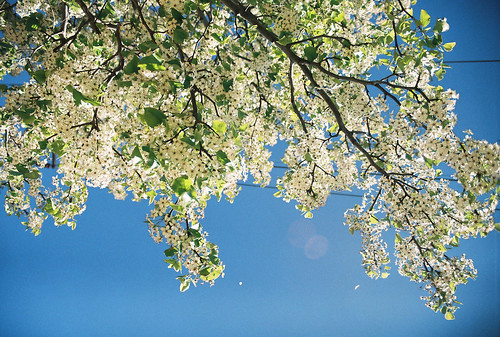
it seemed normal, even likely at the time. this hope.
(petals falling though it wasn't windy,
sunny though it wasn't warm,
pollen though i couldn't smell it,
sky though we couldn't reach it,
light though it wasn't blinding,
tree though it was more flower,
powerlines though barely showing,
sunny though it wasn't warm,
pollen though i couldn't smell it,
sky though we couldn't reach it,
light though it wasn't blinding,
tree though it was more flower,
powerlines though barely showing,
spring, though this hope was not really of any season)
Subscribe to:
Posts (Atom)


